
Contents
Overview
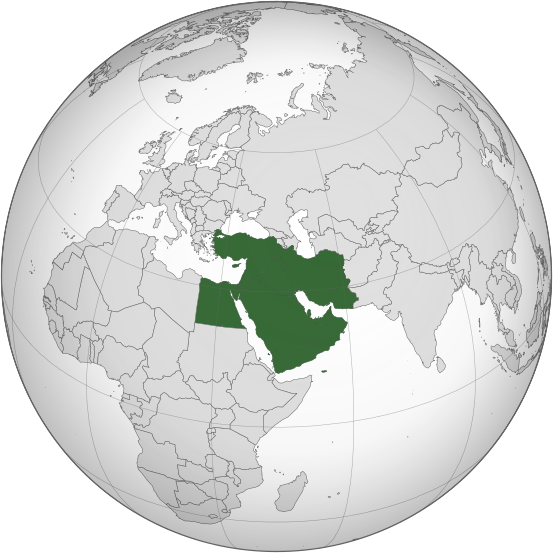
Middle East politics refers to the complex and often volatile interplay of governmental systems, international relations, and internal power struggles within the geographical region commonly known as the Middle East. This region, encompassing Southwest Asia and parts of North Africa, is characterized by a diverse array of political structures, from monarchies and republics to theocratic states, and is a critical nexus of global energy resources, ancient cultural heritage, and ongoing geopolitical rivalries. Key dynamics include the persistent challenges of political stability, sectarian divisions, and the rise of non-state actors. Understanding Middle East politics requires grappling with historical legacies, religious influences, and the competing interests of regional and international players.
🎵 Origins & History
The political landscape of the Middle East is a product of millennia of history, shaped by empires, religious movements, and colonial interventions. Ancient civilizations like the Mesopotamians and Egyptians laid foundational structures. Empires such as the Persian, Roman, Byzantine, and Ottoman empires existed in the region. The discovery of vast oil reserves in the early 20th century further cemented the region's global strategic importance, attracting external powers and influencing internal political developments, particularly the rise of Arab nationalism and subsequent independence movements.
⚙️ How It Works
Middle East politics operates through a spectrum of governmental systems. Absolute monarchies like Saudi Arabia and UAE, parliamentary republics such as Lebanon and Iraq, and the unique theocratic republic of Iran are present. Power dynamics are often characterized by a delicate balance between ruling elites, tribal structures, religious institutions, and burgeoning civil society movements. The presence of significant non-state actors, such as Hezbollah in Lebanon and Hamas in Palestine, further complicates governance and regional stability, challenging the sovereignty of established states and influencing diplomatic efforts.
📊 Key Facts & Numbers
The Middle East is home to approximately 5.8% of the world's population, with over 200 million people. The region holds an estimated 60% of the world's proven oil reserves, with countries like Saudi Arabia producing over 10 million barrels per day. Military spending in the region exceeded $150 billion in 2022, reflecting ongoing security concerns and arms races. The Arab League, founded in 1945, comprises 22 member states, aiming for cooperation but often hampered by internal divisions. The Gulf Cooperation Council (GCC) (founded 1981) represents a more tightly integrated bloc of six Arab states, focusing on economic and security coordination. The region's GDP is heavily influenced by oil exports, with the top oil-exporting nations generating trillions of dollars annually.
👥 Key People & Organizations
Key figures and organizations profoundly shape Middle East politics. Leaders like Ayatollah Ruhollah Khomeini (Iran), Gamal Abdel Nasser (Egypt), and Yasser Arafat (Palestine) defined major political currents of the 20th century. In contemporary politics, figures such as Mohammed bin Salman (Saudi Arabia), Recep Tayyip Erdoğan (Turkey), and Bashar al-Assad (Syria) wield significant regional influence. Major political entities include the aforementioned Arab League and Gulf Cooperation Council (GCC), as well as influential non-state actors like Hezbollah and Hamas. International players like the United States, Russia, and China also exert considerable influence through diplomatic, economic, and military engagement, often supporting specific regimes or factions within the region.
🌍 Cultural Impact & Influence
The political dynamics of the Middle East have had a profound global impact, primarily due to its strategic location, vast energy resources, and the enduring Israeli-Palestinian conflict. The region's political instability has frequently led to global energy price fluctuations and has been a major driver of international diplomacy and military intervention, particularly by Western powers. The rise of Islamism as a political force, originating in parts of the Middle East, has influenced political movements and security concerns worldwide. Furthermore, the cultural and religious significance of cities like Jerusalem and Mecca means that political developments in the region resonate deeply with billions of people globally, influencing religious discourse and interfaith relations.
⚡ Current State & Latest Developments
As of 2024, Middle East politics is marked by several critical developments. The ongoing Syrian Civil War continues to destabilize the Levant, with various international powers maintaining a presence. Tensions between Iran and Israel have escalated, particularly concerning Iran's nuclear program and its regional proxies. The Abraham Accords, normalizing relations between Israel and several Arab states, continue to reshape regional alliances, though the Israeli-Palestinian conflict remains a persistent flashpoint. Economic diversification efforts are underway in oil-dependent states like Saudi Arabia and the UAE to reduce reliance on hydrocarbons. The aftermath of the Arab Spring continues to influence political discourse, with varying degrees of democratic progress and authoritarian resurgence across different nations.
🤔 Controversies & Debates
Middle East politics is rife with controversies and debates. The definition of the 'Middle East' itself is contested, with some scholars preferring terms like 'West Asia' or including North African countries. The legacy of colonialism and the Sykes-Picot Agreement remains a point of contention, with many arguing it created artificial states that are inherently unstable. The role of external powers, particularly the United States and Russia, in shaping regional conflicts and alliances is heavily debated. The rise of political Islam and its various manifestations, from moderate parties to extremist groups, sparks ongoing discussions about governance, secularism, and religious freedom. The Israeli-Palestinian conflict is perhaps the most enduring and polarizing controversy, with deeply entrenched narratives and competing claims to land and self-determination.
🔮 Future Outlook & Predictions
The future of Middle East politics is likely to be shaped by several key trends. Continued competition between Iran and Saudi Arabia will probably persist, potentially leading to further proxy conflicts or, optimistically, a de-escalation through diplomatic channels. The long-term impact of climate change on water scarcity and resource management could exacerbate existing tensions and create new geopolitical challenges. The ongoing economic diversification efforts in Gulf states may lead to shifts in global energy markets and new forms of regional economic integration. The potential for further normalization of relations between Israel and Arab states, alongside efforts to resolve the Israeli-Palestinian conflict, remains a significant variable. The influence of youth demographics, with a large young population across the region, could drive demands for political reform and economic opportunity.
💡 Practical Applications
The political structures and dynamics of the Middle East have direct practical applications in international relations, security studies, and economic forecasting. Understanding the region's political landscape is crucial for global energy markets, as disruptions in major oil-producing nations like Saudi Arabia or Iraq can have worldwide economic repercussions. Diplomatic efforts by organizations like the United Nations and individual nations are constantly engaged in managing conflicts, mediating disputes, and providing humanitarian aid, all requiring deep knowledge of local political contexts. Furthermore, the region's role in global counter-terrorism efforts and its impact on migration patterns necessitate continuous political analysis and strategic planning by governments and international bodies worldwide.
Key Facts
- Category
- politics
- Type
- topic